Call-to-CRM Voice AI for Field Sales Teams
Your reps call one number. Your pipeline tells the truth.
After a meeting, your rep calls June from the parking lot. She asks the questions you’d ask on a ride-along, and it comes back structured. So you see the whole team, not just the reps you ride with. And you hear a deal is stalling while it’s still a deal.
Works with your CRM. Works without one. June writes to whatever system you choose, and follows you when you switch.
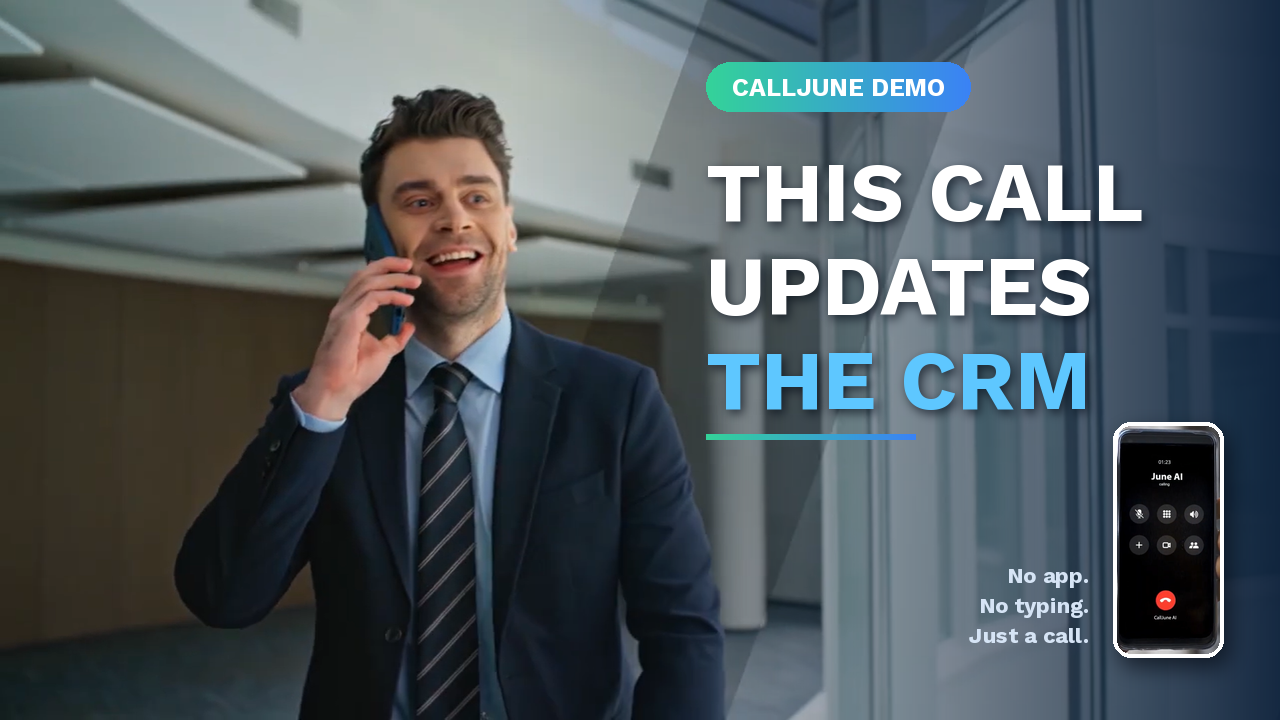
"Hi Scott, are we logging an update, or opening a new opportunity?"
The Teammate That Keeps Deals Sharp and Pipelines Honest.
Imagine having a teammate your reps can call anytime after meetings to capture what happened and what’s next. June asks manager-grade questions, then logs the notes, next steps, and forecast inputs into your CRM or system of record so leaders can coach while the deal is still winnable.
How June works, in the flow of a real sales day
Rep calls June
A few minutes, right after the meeting, while the details are still fresh.
June asks your questions
The ones a good manager would ask. Minimal or manager-grade. Your call.
Your system gets updated
Notes, next steps, tasks, and forecast inputs. Written to your CRM or spreadsheet.
Rep moves on
No app. No typing. No end-of-week cleanup.
The Transcript Has the Words. Your Rep Has the Verdict.
The market’s AI records meetings and summarizes what was said. Good technology, and June is not here to replace it. But the most valuable output of a sales meeting is never spoken out loud: whether the objection was real, whether the champion can actually move money, whether the deal is advancing or quietly dying. That verdict lives in your rep’s head, and it starts fading on the drive home. June calls it out of them while it still exists. And nobody gets recorded. Your rep debriefs after the meeting, so your customer was never on the call. What comes back is the read, not a tape.
What was said vs. what they think
A recorder captures the conversation. June asks for the read: the judgment you hired a seasoned rep to have.
The question nobody asked
If no one asked who signs, no transcript can tell you. June asks in the field, so managers stop re-asking the same five questions in every 1:1.
The meetings that never get recorded
Lobbies, jobsites, trucks. Recording-based AI runs on half your pipeline. June feeds it the other half.
You already bought the AI. June feeds it the half of your pipeline it cannot hear.
Why call-in beats app-based voice tools?
No two-factor prompts. No tapping around a tiny screen. No internet or Wi-Fi needed.
Just a simple hands-free call habit that reps actually use.

Hear it happen
What a call-to-CRM debrief is: June finds the hole in a deal
A few minutes into the debrief, June asks who else has to sign off. The rep does not have the answer, and hears herself say so out loud.

"Who's involved in the final decision? And who else are they considering?"
"Uh, good catch, June. I don't know yet. Go ahead and create a task for me to confirm decision makers and competitors tomorrow."
The rep, in the clip above
Decision makers and competitors. The two things that decide the deal, caught in the parking lot instead of three weeks later, and already on the calendar as a task before the rep leaves.
June works a full SPIN debrief: what problem are we solving, what is the impact, what does success look like. Then deal size, timing, probability, and who else is involved.
That question set is not fixed. We configure it to your sales process and your stages, so every call surfaces what your managers need to know before a deal moves. You do not build it, and your reps do not maintain it.
Read the full call transcript
What a call-to-CRM debrief sounds like end to end. A field sales rep calls June after a meeting and June runs a SPIN debrief by phone.
Rep: Hey June, I just met with Dr. Lee at Riverside Medical Group. They want to replace their bulky ECG setup and roll out our portable units across their clinics.
June: Great. I'm opening a new opportunity in Salesforce. Riverside mobile ECG rollout. What problem are we solving?
Rep: Their current system ties up a room, causes delays, and staff re-enter results manually.
June: What's the impact?
Rep: Patients wait longer, throughput drops, and follow-up visits slip.
June: What does success look like?
Rep: EKGs landing in their EHR within minutes, and patient flow improving. Estimated deal size, let's use 900,000 for now. Target timing, they want it live by the end of next quarter.
June: Probability to close for Salesforce.
Rep: Put 70%.
June: Done. I'll schedule those in Salesforce. One more thing, who's involved in the final decision, and who else are they considering?
Rep: Uh, good catch, June. I don't know yet. Go ahead and create a task for me to confirm decision makers and competitors tomorrow.
June: No problem. I'm creating a Salesforce task for tomorrow to confirm decision makers and competitors. Anything else to log?
Rep: That's it. Thanks, June.
June: All set. Opportunity notes and follow-ups are logged in Salesforce.
The two questions behind CallJune: pipeline clarity and rep performance
How Do I Get Pipeline Clarity?
Reps are busy and out of pocket. Updates land late or never, so the forecast is built on guesses and leaders fly blind.
One call after the meeting. The debrief is written to your CRM the same day, while the rep still remembers what actually happened.
How Do I Help Reps Sell?
Skills slip. Even strong reps forget the qualifying and differentiating questions, the ones that make or break a deal.
She asks them on every call, for every rep, every time. Coaching happens in the field instead of three weeks later in a 1:1.
Built for Clean Pipeline Updates and Better Coaching.

Focus on the customer. June updates your system.

Manager-grade questions, in the flow of work

Catch deal risk earlier, without chasing reps

Your playbook, consistently applied

Works with what you already use
From the founder
Why I built a call-in AI for field sales teams
I spent 25 years in B2B sales, most of it as a rep and then managing teams. Two questions never stopped bothering me: how do I get an honest read on the pipeline, and how do I help my reps actually sell better.
I knew from coaching that even my best reps forgot the qualifying questions that make or break a deal, and that field updates landed late or never. So I built June to ask those questions on every call, for every rep, and write what she hears into the system you already use.
Shawn Johnson, Founder. 25 years in B2B sales as a rep and manager.
.png)
Yes, that is the founder running the demo, and at this stage that is the point. Every partner's configuration, question set, integration and rollout runbook is documented from day one and worked by the founder and the development team from shared records. Coverage does not depend on any one person being available.
Read the full transcript of this demo
Shawn Johnson, founder of CallJune, calls June after a sales meeting, then opens Salesforce to show what she logged.
Shawn: Hi, I'm Shawn, founder of CallJune, here to introduce you to June. Imagine for a minute that I'm on your sales team. I just finished a call with an account. I hop in my car to drive to the next appointment, and while I'm driving, I make a call to June just like this.
June: Hi Shawn. This is June. Thanks for calling in. What are we doing today?
Shawn: Hey June. I just met with Brian over at Echo Electric and we talked about upgrading their fleet charging systems, and he is interested in a three site pilot starting next quarter.
June: That's great news, Shawn. I'll create a new opportunity for this as fleet charging three site pilot. What next steps did you discuss?
Shawn: Next steps would be, if you could schedule this for me, I need to send him a spec sheet tomorrow and also a follow-up appointment for two weeks.
June: Got it. Setting your follow-up tasks with Brian Wheeler to send over the spec sheet today. I'm scheduling your next meeting for two weeks. So, is anyone else involved in the final decision? And do you know who the competition is on this?
Shawn: Oh, no. Good catch, June. I don't know, and I need to find that out. Would you please schedule a task for me in Salesforce to call Brian tomorrow and find that out?
June: Sure thing, Shawn. I'll add a task to call Brian tomorrow about the decision process and any other vendors involved. Is there anything else you want to log from this meeting?
Shawn: No, all good.
June: Perfect. I've logged everything and set your follow-up. Great work today, Shawn. If you need anything else, just call me.
Shawn: Now let's head over to Salesforce and see what June's done for me. Look, it's all been logged. The opportunity was created. All three follow-ups are scheduled. Notes are clean, with no typing, no friction, and no missing next steps. And I was reminded to get the important deal information, and those insights will help me sell better.
Shawn: With a simple call, June has solved two of the major problems facing sales teams. One is poor data ingestion from the field, because reps are often busy and out of pocket. Two is sales skills slippage. I know from years of coaching sales reps that even the best ones will often forget to ask the key qualifying and differentiating questions, the questions that can make or break a deal. These issues regularly cause sales to be missed and sales leaders to be flying blind because of inaccurate forecasts.
Shawn: Conversational AI flips that on its head, because June makes sure nothing slips between the cracks. She knows my CRM, she knows my playbook, and she knows me. We gave her memory, sales skills, and emotional intelligence, because she helps me remember what matters. She helps me structure my thoughts and update my CRM. Of course, June can't solve all my sales or pipeline issues, but she can certainly help improve my data hygiene, my reps' performance, and my win rates.
Security and Data Boundaries
Tight footprint. Clear data boundaries. Practical controls.
CallJune is designed for least-privilege access, and retention can be configured based on your requirements.
Security and Compliance.avif)
Frequently Asked Questions
Explore our FAQ section for quick answers to common queries. Save time and get helpful information about our services, support, and processes in one place.
June is a call-in assistant reps use right after meetings. She captures the deal story, next steps, and forecast inputs, then writes the update into your CRM or a spreadsheet so the pipeline stays current and coachable.
No. June updates your system of record. And she’s not trying to hand you a raw transcript. She runs a guided debrief and turns what the rep says into structured updates you can actually use: notes, tasks, next steps, and forecast details.
Yes. June can write to Salesforce and other CRMs, and she can also log to a spreadsheet. We map the objects and fields you care about (opportunities, notes, tasks, next steps, forecast inputs), then June writes updates based on your rules and your process.
June is call-first, not app-first. Reps just call. No logins. No two-factor prompts. No tapping around a screen. It’s hands-free and works in the flow of a real day, especially between meetings or on the road. The goal is adoption: a simple habit that actually happens.
Yes. You can keep questions minimal or make them manager-grade. June can follow your methodology (SPIN, MEDDIC, stage discipline, and your internal standards) so every rep is held to the same bar without adding more process.
Setup is light. We align on where updates should land (CRM or spreadsheet), and what questions you want June to ask, then you're live. Founding Customer pilots carry an onboarding fee of $400 to $900, credited in full to your first month, instead of the standard $2,000 to $9,000 implementation.
Keep them. They are good at what they do: capturing what was said on recorded calls. June captures what your rep thought, on the meetings that never get recorded. The rep calls June after the meeting, she asks your questions, and the update lands in the same CRM your AI already reads. A smarter agent on a fuller record is a better agent.