
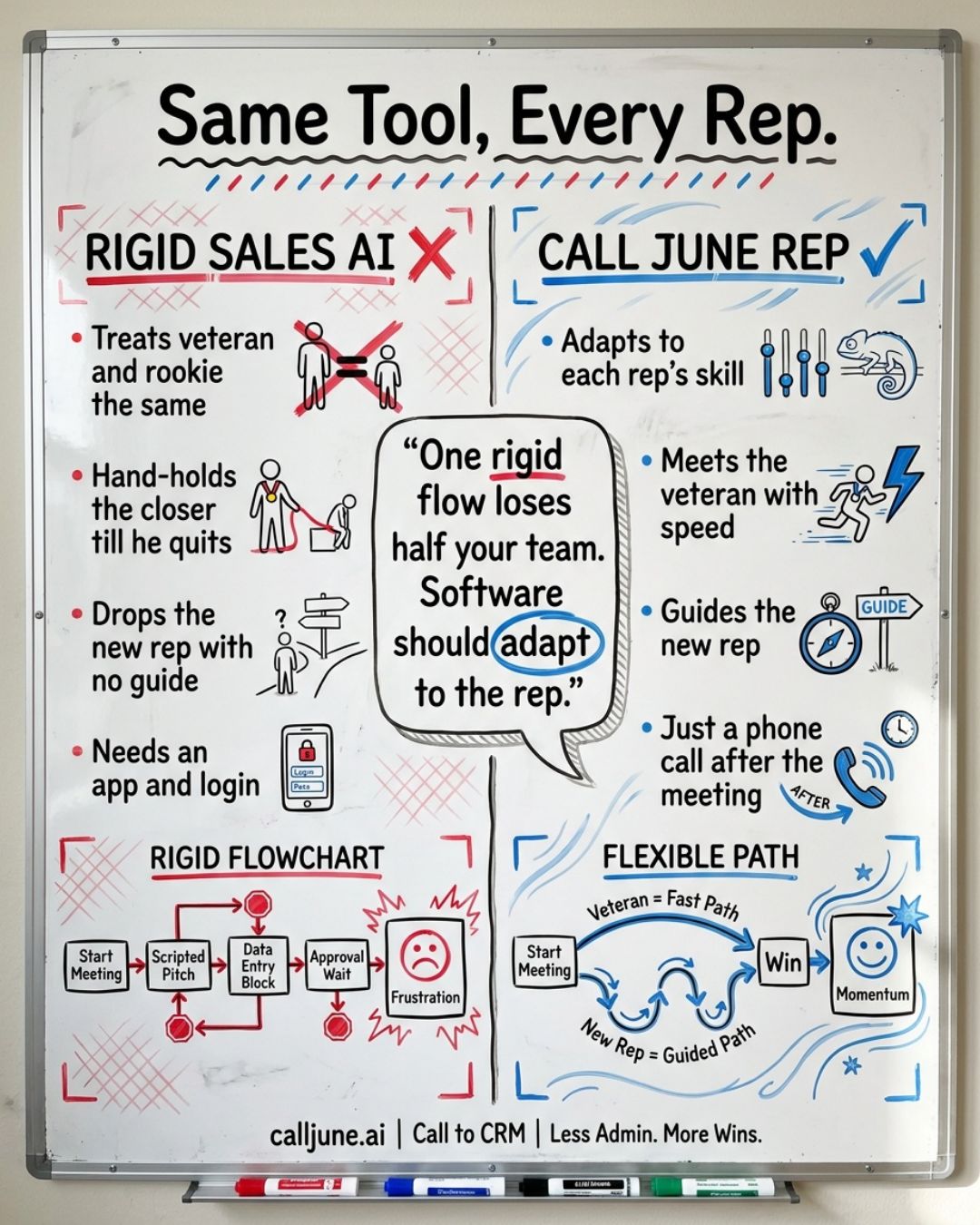
TL;DR: Reps abandon sales AI when it treats a 20-year closer and a 90-day rookie the same way. Veterans resent the hand-holding, new reps drown without it, and one rigid flow loses half the team. The tools that stick adapt to the person. With Call-to-CRM, the rep calls June after a meeting, and because she knows their skill level and how they like to work, the same debrief feels right to a veteran and a rookie.
Why do sales reps stop using AI tools?
Reps drop tools that feel generic and add work.
A new tool earns its place only when it fits the actual job. When it does not, reps quietly route around it, and adoption dies in the field where no dashboard can see it.
Part of this is history. Reps carry a natural skepticism toward new tech because past management initiatives failed them. The pattern is well documented in distribution and field sales, where reps have learned to wait out the next rollout (NAW).
So the bar is higher than "does it work." The bar is "does it work for me, the way I actually sell."
Why does one-size-fits-all AI lose half the team?
Because a sales team is not one user. It is two, at least.
Your veterans need you to get out of the way. They have run a thousand debriefs and they want speed, not a tutorial. Make them sit through guidance built for a rookie and they will stop using the tool by week two.
Your new reps need the opposite. They do not yet know which questions matter, so a blank box or a fast flow leaves them guessing. They need a guide.
A single rigid flow cannot serve both. It either slows the veteran down or leaves the rookie behind. Either way, you lose half the team, and a half-adopted tool is a tool nobody trusts the data from.
How do I get veteran and new reps to adopt the same tool?
Use one that adapts to each rep's skill and style instead of forcing every rep into the same script.
The teams with strong adoption do not pile on tools. They embed one or two that fit the real work and let the habit go automatic (Fyxer). The fit is the whole game. A tool that bends to the rep gets used. A tool the rep has to bend to gets abandoned.
That means the same tool needs to meet a veteran with speed and a rookie with structure, without the rep having to configure anything. The software adapts. The rep just does their job.
What makes a voice AI worth using for field sales?
It augments the human rep instead of flattening everyone into one flow.
This matters because the human still closes. 69% of B2B buyers turn to reps to validate AI insights, so the rep is not going away, and the tooling has to sharpen the rep rather than replace their judgment (Gartner via Demand Gen Report).
A voice AI worth using respects that. It captures what happened in the field while the recall window is still open (a rep has roughly 3 to 5 minutes of perfect recall on the walk from the conference room to the car), and it shapes the debrief to the rep in front of it.
Where Call-to-CRM fits
Here is the differentiator, stated plainly once.
Most sales AI is voice-to-CRM dictation. The rep opens an app, logs in, and reads notes into a one-way command box. The tool records what the rep chose to say. It does not ask, and it treats every rep the same.
Call June is Call-to-CRM. The rep calls June when they are ready, on the drive home or in the parking lot. June picks up and guides the debrief, asking the qualifying questions a sharp manager would ask on a ride-along. The rep always initiates the call. June never calls the rep.
The part that makes adoption stop being a fight is the memory axis. June's memory is rep-centric. She remembers each rep's skill level and how they like to work, so the same call meets a veteran with speed and a rookie with more guidance. Adaptive AI does not replace coaching. It makes coaching land by meeting the rep where they are.
FAQ
Why do reps abandon AI tools?
They feel generic and add work. When a tool treats every rep the same and creates more steps than it saves, reps quietly stop using it in the field.
How do I get veterans and rookies on the same tool?
Use one that adapts to each rep's skill and style. A tool that meets a veteran with speed and a rookie with structure gets adopted across the whole team instead of half of it.
Does adaptive AI replace coaching?
No. It makes coaching land by meeting the rep where they are, capturing the real debrief so managers coach on what actually happened rather than what the rep remembered to type.
Sources: NAW, Fyxer, Gartner via Demand Gen Report. Stats cited inline. CallJune internal narrative for the recall window.