
By Shawn Johnson, Founder, CallJune.ai. Published September 16, 2026.
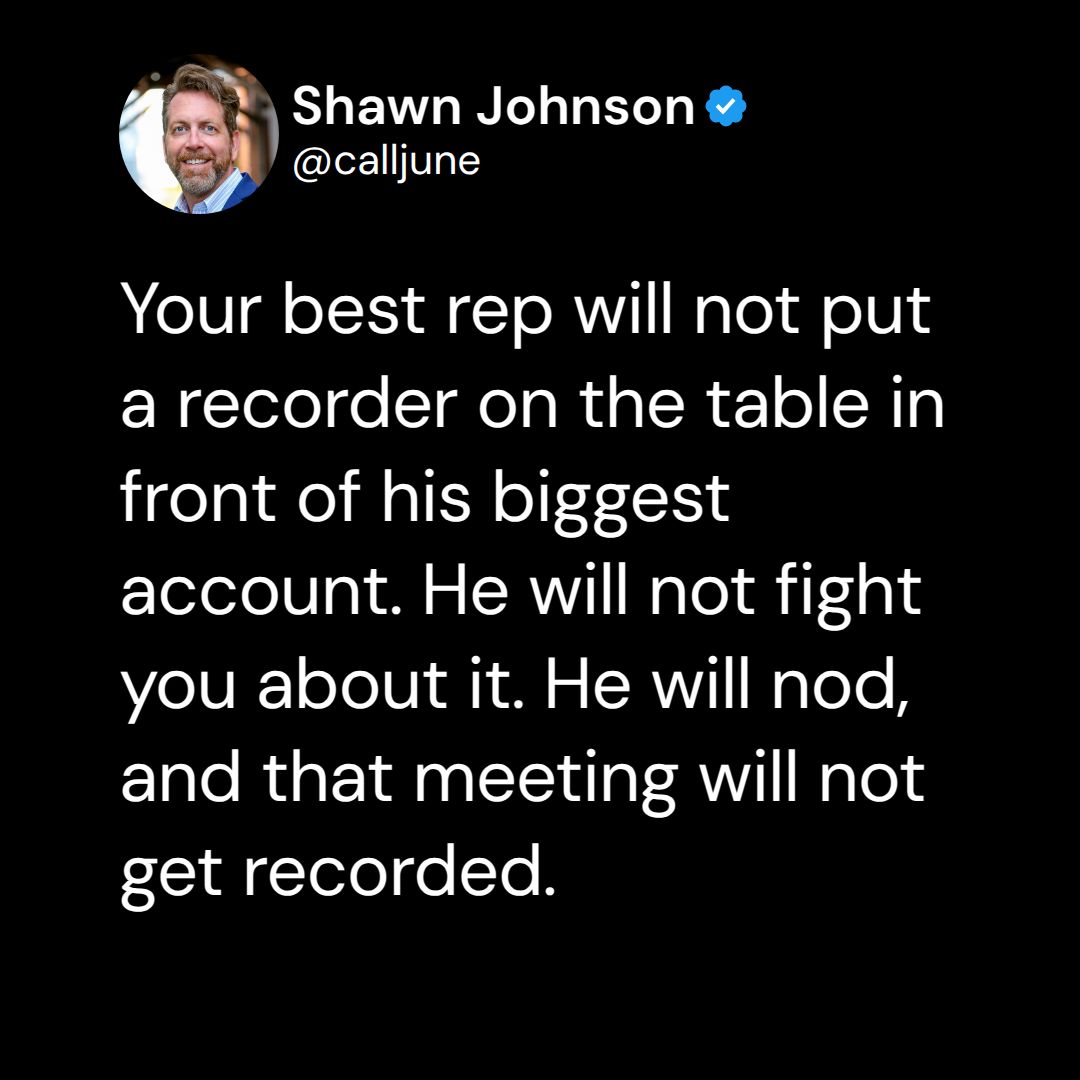
Because the relationship belongs to the rep, not to the company. A field rep will not put a recorder on the table in front of the account he has spent eight years building. He will not argue with you about the policy either. He will nod, and that meeting will quietly go untaped. Add the buyers who decline outright, and the coverage gap in a recording-based system stops being random. It is thinnest right where the stakes are highest. Call to CRM closes that gap a different way. The rep calls a number after the meeting, answers a manager's questions in a few minutes, and the structured notes land in the CRM. Nothing in the customer's room ever gets recorded.
Why don't sales reps record their most important meetings?
Picture the drive. A field rep pulls into the lot at his largest account. He knows the buyer's kids by name. He has been working this building for eight years.
That relationship is the one asset he actually owns. He built it, he carries it, and it goes with him wherever he works next. Handing the company a permanent tape of it is handing over the thing he takes to his next job.
So he walks in with a notepad and leaves the recorder in the truck.
This is not disloyalty and it should not be managed as though it were. It is rational self-protection, and any leader who has carried a bag understands it in about two seconds. The mistake is designing a capture strategy that assumes it will not happen.
Is call recording reliable for pipeline visibility?
It is reliable for the meetings that get recorded. Inside sales records itself, because the call already happens on a platform that captures it. That is genuinely useful, and the conversation intelligence built on top of it does real work.
Field sales is a different picture. The meeting happens in a lobby, on a jobsite, across a distributor's counter, in a truck at the end of a gravel driveway. Recording a customer in their own building is a relationship act before it is a legal one, and the law is not uniform either. Consent rules vary by state, with some requiring one party's consent and others requiring everyone's. This is not legal advice. Check with counsel before you write a policy.
The numbers around field capture point the same direction. About 87 percent of sales organizations use AI. Roughly a third of field sales teams use none at all (SPOTIO, State of Field Sales 2026). Roughly 79 percent of what happens in an opportunity never reaches the CRM (Salesforce, State of Sales).
Recording-based tools also need the recording to exist before they can do anything. Enabling capture is the documented first setup step, not an optional extra (Sidekick Strategies, HubSpot Notetaker with Smart Deal Progression).
Why is the gap worst on the biggest deals?
Two filters run at once, and they push the same way.
The first is the rep. He protects the accounts he values most, so the meetings he skips are the ones attached to his largest and most personal relationships.
The second is the buyer. Some say no when you ask. Some say nothing and go quiet the moment a bot joins the call. Some sit inside a regulated shop where it was never on the table.
Stack those two filters. Your AI ends up with a clean picture of the small transactional business. Over the three accounts that make your number, there is a blank space. A sales leader does not need a study to feel why that is a problem. The deals you most want to see are the ones you can see least.
Can you just mandate recording?
You can compel a rep. You cannot compel his customer.
A mandate also asks the rep to choose between protecting a relationship and reporting a deal. No good manager wants to force that choice. The rep will make it quietly, in his own favor, and you will never see the decision get made. You will only see a thin file.
How do you get visibility into deals that are never recorded?
Ask the rep afterward, while the answer is still real.
That is the whole mechanic behind Call to CRM. The rep calls June from the truck on the drive out. She asks the qualifying questions a sharp manager would ask on a ride-along. He talks it through for three to five minutes. The structured update lands in the CRM the same day. No app, no login, no typing.
Nothing in the customer's room is ever recorded, so the buyer's comfort and your pipeline data stop being a tradeoff. The rep keeps the relationship. The manager gets the read. Call audio and transcripts from the rep's own debrief are retained in the voice platform. Immediate deletion after processing is a configurable setting. It can be enabled for you before go-live on request.
The point is not that recording is bad. Recording is fine where it is welcome. The point is that a capture method that needs no recording has no coverage ceiling, and your biggest accounts stop being your biggest blind spot.
FAQ
Do reps record every customer meeting?
No, and the ones they skip are rarely random. Reps protect their most valuable relationships, so the gap clusters on the largest accounts.
Can I just mandate recording?
You can compel a rep. You cannot compel their customer, and a mandate does not change a buyer's willingness to be taped.
How do you get visibility without recording?
Ask the rep afterward. A guided phone debrief right after the meeting captures the deal without ever taping the customer.
Is it legal to record a sales meeting?
Consent law varies by state, with one-party and all-party rules both in force somewhere. Check with counsel before setting policy.
Sources: SPOTIO State of Field Sales 2026; Salesforce State of Sales; Sidekick Strategies on HubSpot Notetaker.