
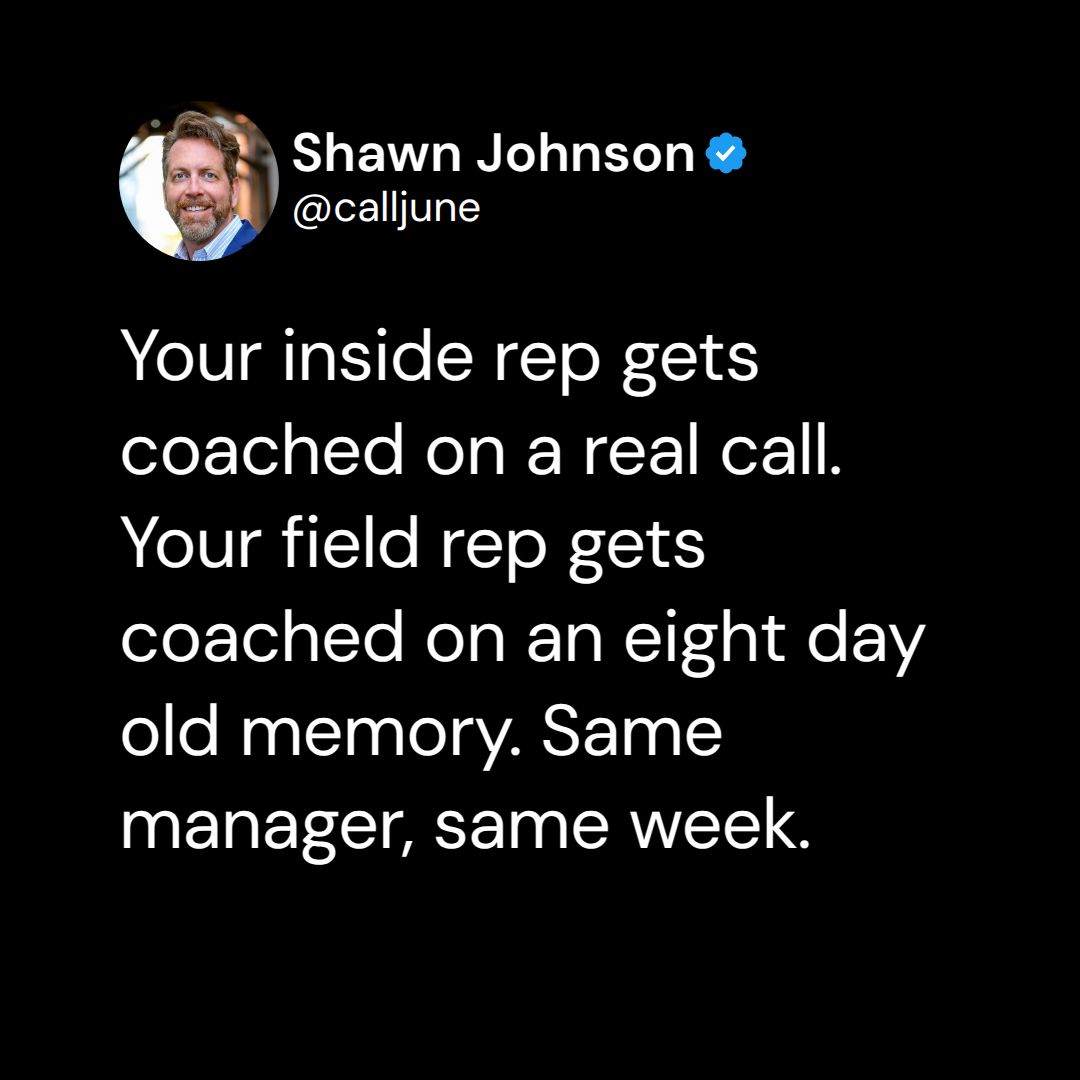
Good coaching points at a real moment. A manager pulls up a call and goes to the part where the deal turned. Then he works one thing with the rep. An inside sales team makes that moment on its own, because the call already sits on a screen. A field meeting in a lobby makes nothing. So the manager coaches from a memory that is a week old. The way out is not a recorder in the room. Have the rep talk the meeting through right after it happens, by phone, against your own questions. Then there is something real to open on Monday. That is Call to CRM. The rep calls June, she asks the questions, and the answers land in the CRM you already run.
Why does sales coaching work for inside sales but not field sales?
Because one of them leaves a record of itself and the other does not.
An inside rep's call is already on a line that gets logged. The manager can go to minute twelve. He can play eight seconds, ask the rep what he heard, and try it again. Every coaching guide says the same thing. Sit with the rep. Point at a real moment. Work one skill.
Now put the same manager in front of a field rep. Two meetings last week, one on a jobsite and one in a back office. There is nothing to pull up. So the manager asks how it went. The rep says it went fine. The session turns into a forecast conversation.
That manager has nothing in front of him.
How much coaching time does a front line manager actually have?
Very little, which is why the missing record costs so much.
About 73 percent of front line sales managers get under 30 minutes per rep per week for coaching. That figure comes from Sales Assembly's 2026 coaching review. Half an hour works if you walk in knowing what happened. It does not work if the first fifteen minutes go to finding out.
Gong looked at what separates teams that coach weekly from teams that do not. The reps who get one real coaching conversation a week win 19 percent more deals. So this shows up in the number, not just in morale.
The belief is already in the building. Seventy nine percent of sellers say coaching in the moment makes them better. Only 12 percent say their company works it into the day to day (Varicent, Sales Performance Statistics 2026).
Managers want to do this and they are trying. What they are missing is the input.
Should we just record field meetings?
Rarely worth it, and it will not close the gap anyway.
Consent law varies by state. Recording a customer inside their own building is a relationship decision before it is a legal one. Reps also protect their biggest relationships from a permanent tape. So your coverage ends up thinnest over the accounts that make your number.
There is also nothing to work from yet. About a third of field sales teams use no AI at all today (SPOTIO, State of Field Sales 2026).
The tools that read inside sales calls are good at what they do. Gong, HubSpot and Salesforce all solved the half of the pipeline that sits on a screen. The field half needs a different input, not a better reader.
What do you use for coaching when there is no transcript?
The rep's own account of the meeting, taken while it is still true.
The mechanic is a phone call. The rep finishes a meeting, walks to the truck, and calls a number. June picks up and asks your questions. What the buyer actually said. Who is going to sign. What changed today. What happens next.
Three to five minutes of talking it through. No app, no login, no typing. Nothing gets recorded in the customer's room. The structured result lands in the CRM the same day.
Two things come out of that which a transcript never gives you. The first is the rep's read on whether the deal is really moving. That verdict lives in his head and it decays fast. The second is a record the manager can open on Monday and point at.
CallJune configures the question set to your process during onboarding. Reps answer your qualification, not a generic script.
Frequently asked questions
Can you coach field reps without recordings?
Yes. You need something real to point at, and a guided phone debrief right after the meeting gives you that. The rep's own structured account becomes what you open in the one on one.
Why is coaching from memory weak?
By the time the one on one happens, the rep is rebuilding the meeting rather than reporting it. You end up coaching a summary.
Should we record field meetings to fix this?
Usually not. Consent law varies by state, and recording a customer in their own office carries a trust cost. Reps also protect their most valuable relationships from a tape, so coverage is worst where the stakes are highest.
How long does the debrief take?
Three to five minutes on average. Longer if your question set is intake heavy, which is a configuration choice you make.
Does the rep need an app?
No. It is a phone call from a number registered with June, plus a per rep PIN. No app, no login, and no internet needed in the field.
By Shawn Johnson, Founder, CallJune.ai. Published September 22, 2026. Sources: Sales Assembly, How to Coach Sales Reps in 2026. Varicent, Sales Performance Statistics 2026. SPOTIO, State of Field Sales 2026. Gong 2025 coaching research.