
The highest-leverage coaching habit a field sales manager has is a standing debrief: the same short set of qualifying questions after every customer meeting, asked while the detail is still fresh. A workable set covers next step and owner, decision process, risk, competition, and amount and timing. Consistency beats cleverness, because reps internalize a question set they can predict and start gathering the answers in the room. The constraint is arithmetic: a manager can ride along with one rep at a time, so most meetings get no debrief at all. The Call-to-CRM version closes that gap. The rep calls June after every meeting, June asks the manager's questions, and the answers land in the CRM.
What should the standing question set cover?
Five is about right. More than that and the debrief becomes a form.
1. Next step and owner. Not "they're going to think about it." What happens next, on what date, and whose name is on it.
2. Decision process. Who else touches this, and what has to be true before anyone signs.
3. Risk. What could kill this deal, in the rep's own judgment.
4. Competition. Who else is in the room, named or implied.
5. Amount and timing. The number, and when.
The specific five matter less than the fact that they never change.
Why ask the same questions every time?
Because predictable questions get internalized.
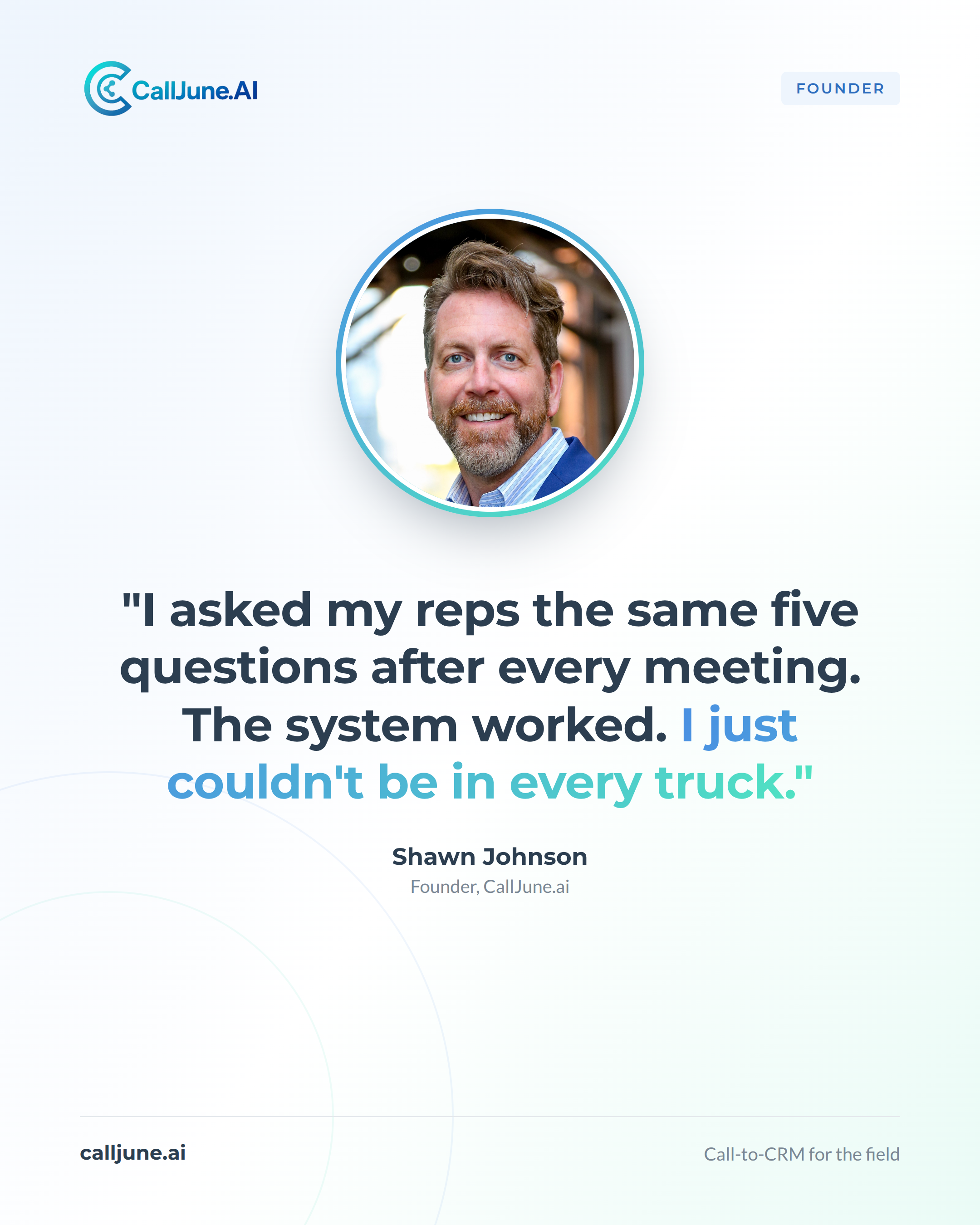
I spent 25 years in B2B sales, most of it as a rep and then as a manager. The most useful thing I did as a manager was not clever. It was asking my reps the same debrief questions after every ride-along, every time, until they could hear them coming.
That predictability was the whole system. The reps knew what was coming, so they started preparing the answers during the meeting itself. And to prepare the answers, they had to listen for them in the room. The debrief was not paperwork. It was practice, and the practice happened before the debrief, which was the point.
The questioning research backs this up as more than a personal habit. Huthwaite's observation of roughly 35,000 sales calls found that what separated top performers was not pitching or closing, it was questioning (Salesforce, What Is SPIN Selling?).
What breaks this system?
The calendar.
Here is the confession that goes with the story. I could only be in one truck at a time. The debrief only happened when I was there, and most meetings happened without me. So the coaching mechanism I believed in most was also the one that reached the smallest fraction of my team's actual selling.
That is not a discipline problem, and no amount of management rigor solves it. It is arithmetic. One manager, eight reps, four meetings a day each. The math never closes.
How do you scale a ride-along debrief?
You separate the questions from the person asking them.
The value was never that it was me in the passenger seat. The value was that the same five questions got asked, consistently, inside the recall window, and that someone was on the other end listening for the answers.
Once you see that clearly, the debrief becomes portable.
How CallJune runs it
The rep calls June after a meeting, from any registered phone, and talks it through for three to five minutes. She asks your team's questions, the ones your best manager would ask, confirms what she heard, and writes the structured update into your CRM. No app, no login, no typing.
The debrief I ran from the passenger seat, June runs from any parking lot in the territory. Same questions. Every rep. Every meeting.
She does not replace the manager. She makes sure the manager's questions reach every call, including the ones the manager will never attend, so the weekly one-on-one starts from what happened rather than from what anyone can still remember.
Frequently asked questions
What should the standing question set cover?
Next step and owner, decision process, risk, competition, amount and timing. The same five every time is the feature, not a limitation.
Why the same questions every time?
Predictable questions get internalized. Reps start listening for the answers during the meeting itself.
What breaks this system?
The calendar. It only works when the manager is present, which is why it needs a way to run without the manager.