By Shawn Johnson, Founder, CallJune.ai. Published September 16, 2026.
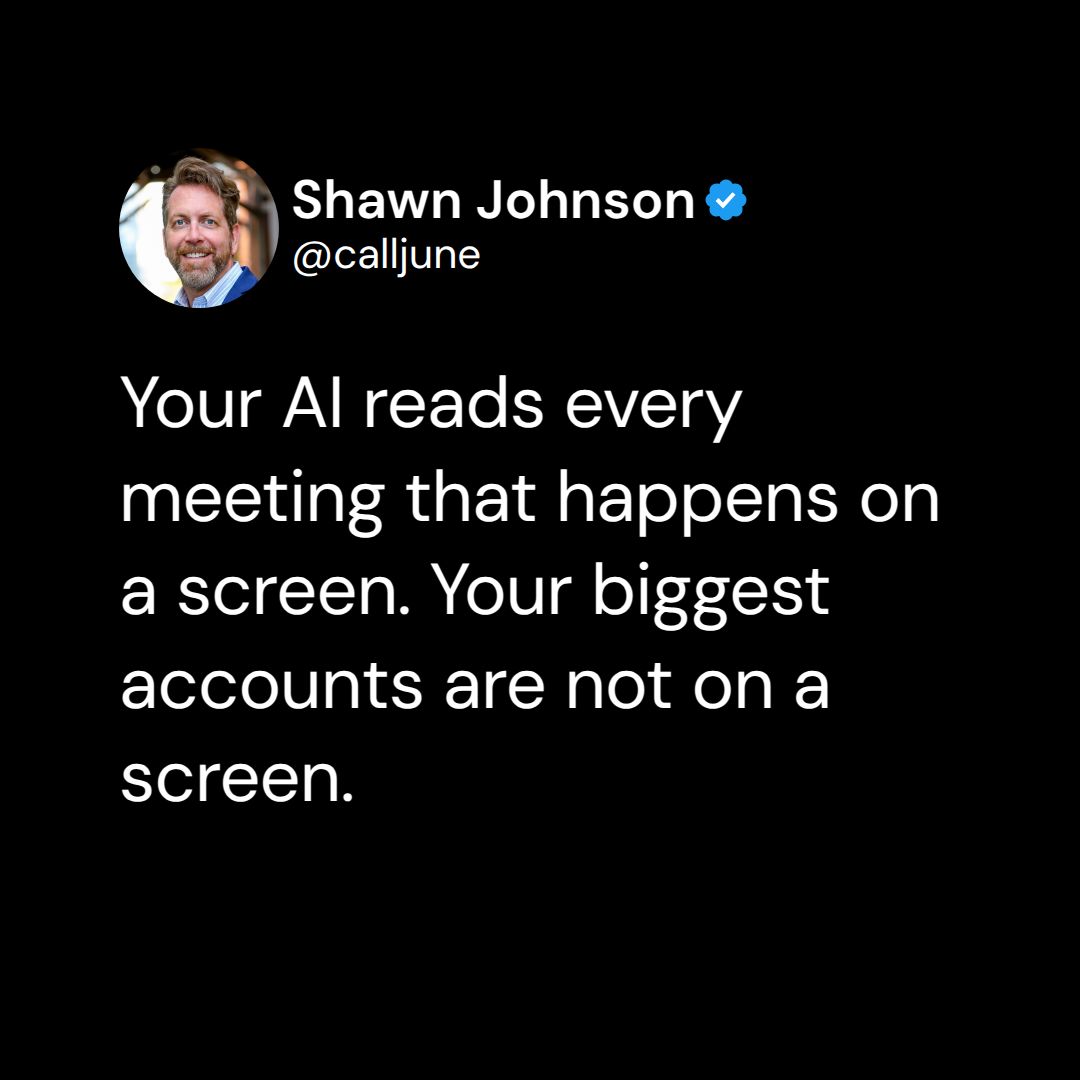
The short answer. Most sales AI runs on recorded calls, so it only sees the meetings that were recorded. Inside sales records itself on video. Field meetings happen in lobbies, on jobsites and in trucks, and they record nothing. That leaves the AI you are paying for working one half of your pipeline. You close the gap by capturing the field meeting a different way. The rep calls a number on the drive back and answers a set of manager-grade questions. Structured notes land in the CRM your AI already reads. That is Call-to-CRM, and it feeds the AI you already bought.
Why does my sales AI miss in-person meetings?
Because it was never fed them.
Conversation intelligence, deal-progression agents and the AI built into HubSpot and Salesforce all work off something that was captured. A video call produces a recording and a transcript without anyone doing anything. That is a clean input, and the tools are genuinely good at reading it.
A field meeting produces nothing. A rep walks into a distributor's back office. He spends forty minutes with a buyer, walks out, and drives to the next stop. There is no file. Nothing was written down. Whatever he concluded in that room is in his head. By the third stop of the day it is already fading.
So the coverage of your AI tracks one thing: where a digital record already exists. Inside sales makes one on every call. Field sales makes none.
How big is the gap?
Bigger than most leaders assume, and it shows up in adoption data.
SPOTIO surveyed 452 sales professionals for its 2026 State of Field Sales report. A third of the field sales teams surveyed use no AI in any capacity. Not for email, not for CRM entry, not for forecasting. By comparison, Salesforce's 2026 State of Sales found 87 percent of sales organizations overall use some form of AI. Same industry, same year, and the teams carrying the most in-person deals are the ones working with the least help.
Among the field teams that have adopted something, the pattern is entry-level. Email personalization and call analysis lead. The ones with the highest upside are used least. Lead scoring, forecasting and customer behavior analysis are each used by fewer than one team in five.
The same survey found field reps spend 44 percent of their time selling. For B2B field reps it is 33 percent. Most of the rest goes to admin and CRM entry. So the field half is the least visible to your AI. It is also the most expensive to document by hand.
Source: SPOTIO, The State of Field Sales 2026, survey of 452 sales professionals, March 2026.
Should I just record field meetings to fix it?
Rarely worth what it costs you.
Consent law is the obvious problem, and it varies by state. The quieter problem is the relationship. A buyer who has known your rep for eight years responds differently to a phone on the table. Some say no outright. Some say nothing and simply become less candid.
Reps read that room faster than any policy does. A recording mandate gets you the small meetings. It misses the ones you most wanted to see.
Recording is not useless. It is genuinely good for training, for ramp, and for settling a dispute about what was agreed. It is just the wrong instrument for a lobby.
How do I give my CRM's AI visibility into field sales?
Capture the meeting after it happens, by phone, and write it into the CRM.
That is the whole mechanic behind CallJune. The rep calls June from the truck on the drive out. June asks the questions your managers would ask on a ride-along. Who else is involved in the decision. What actually moved. What is the risk on this one. The rep talks it through for three to five minutes. June writes a structured record into HubSpot, Salesforce or a shared sheet.
No app. No login. No typing. Nothing is recorded in the customer meeting, because June is never in the customer meeting.
Two things follow from that. First, the field half of your pipeline lands in the same system your AI is already reading. The agent you pay for starts working the whole business instead of the desk-bound part of it. Second, the rep who answers a good question after every meeting starts hearing that question during the next one.
What this means for a sales leader
You do not need a better dashboard. You need the meeting in the system.
If your AI summary is thick on inside sales and thin on the field, the tool is working fine. It is being fed from one side of the house. You can fix that without ripping anything out, and without asking a rep to hand over a relationship.
Start with one question: how much of last week's field activity is in your CRM by Friday? Whatever is missing there is exactly what your AI cannot see.
Frequently asked questions
Does sales AI see in-person meetings?
Only if they were recorded, and field meetings usually are not. Conversation intelligence and deal AI run on captured calls. A meeting in a lobby or on a jobsite produces no recording and no transcript, so there is nothing for the AI to read.
Why do field sales teams use less AI than inside sales teams?
Most AI sales tools were built for inside-sales workflows: desktop access, stable internet, structured CRM data already in place. Field reps work from trucks, doorsteps and parking lots. SPOTIO's 2026 survey found a third of field teams use no AI at all, against 87 percent adoption across sales organizations generally.
Should I require my field reps to record their meetings?
It rarely pays. Consent rules vary by state, buyers behave differently once a recorder is on the table, and reps protect their most valuable relationships. You usually end up with coverage of the low-stakes meetings and a gap over the accounts that matter most.
How do I give my AI visibility into field sales without recording?
Capture the meeting after it ends. The rep calls a number, answers a fixed set of qualifying questions out loud, and the answers are written into the CRM as structured fields. The AI you already own reads that record the same way it reads everything else.
What is Call-to-CRM?
A rep-initiated phone debrief that writes structured notes into your CRM. The rep calls June after a meeting, June asks the qualifying questions, and the record lands in HubSpot, Salesforce or a shared sheet. There is no app to download and no recording of the customer.