
By Shawn Johnson. Published October 20, 2026.
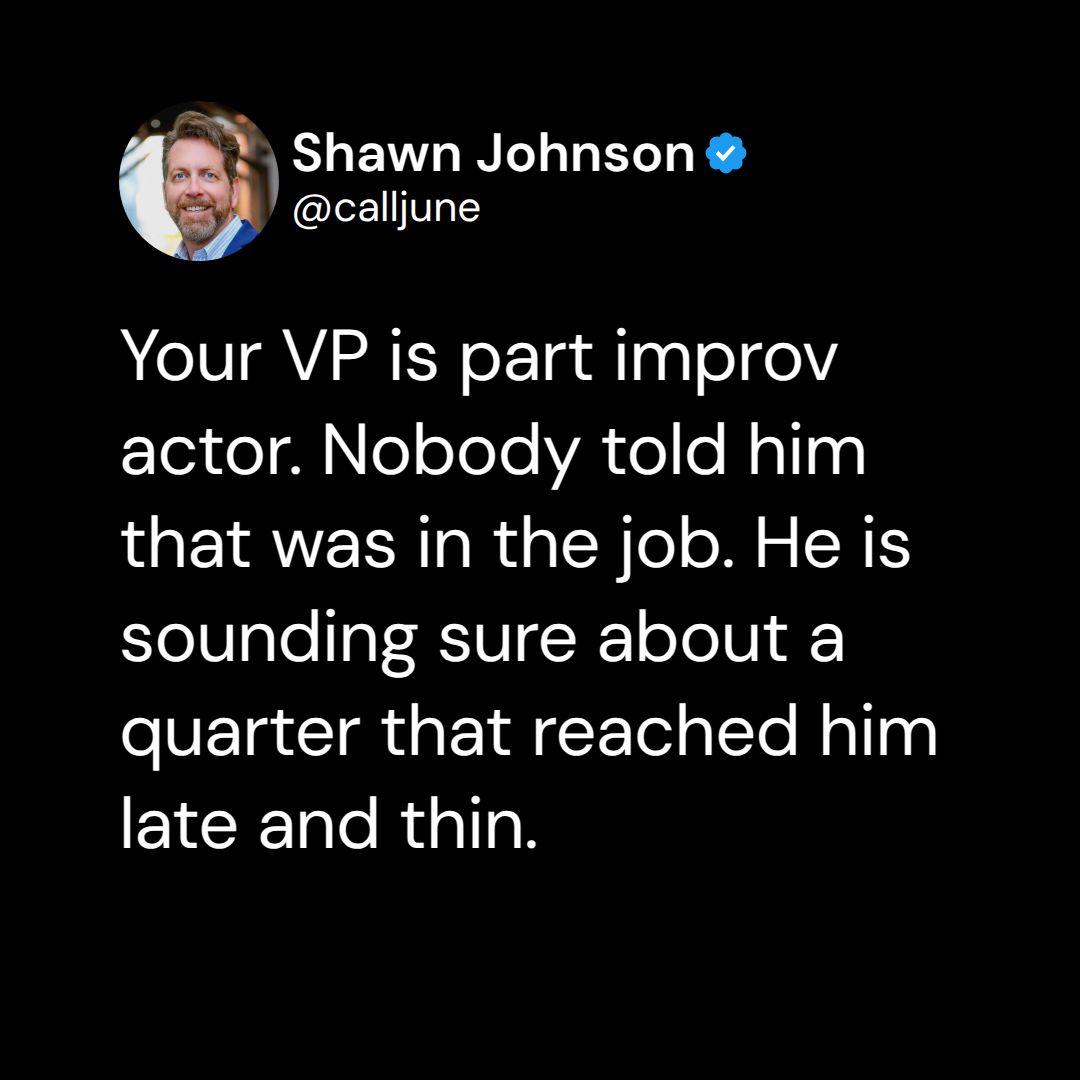
Sales leaders improvise in front of the CEO because the information behind the number arrives late and thin. The rep's read on a customer visit forms on Tuesday. It usually reaches the record days later, from memory. Call to CRM closes that gap. The rep calls June after the meeting. She asks the team's own questions in a guided debrief. The call runs three to five minutes. Structured notes land in the CRM the company already uses. The leader walks in with that week's answers instead of a month-old guess.
Why do sales leaders improvise in front of the CEO?
Picture the VP of Sales in the hallway at 8:52, four minutes out from the boardroom.
He has two jobs in the same sentence. Be persuasive. Do not overcommit. If he sounds unsure, the room starts to worry. If he sounds too sure and the quarter slips, he owns it.
So he improvises. He picks the confident words. He leaves himself room. He reads the CEO's face and adjusts.
Nobody wrote that into the job description. He is also not deceiving anyone. He is working with what he has, and what he has is thin.
What is actually missing from the number?
The useful part of a customer visit is the rep's verdict. Did the buyer move. Who else is in the room. What happens next, and when.
That verdict forms in the parking lot. It does not survive the week.
A rep tours a plant on Tuesday. He has four more meetings before Friday. By the time he sits at a keyboard, the record gets whatever he still remembers. The leader then builds a slide on top of it.
What do sales leaders say about their own forecasts?
Xactly surveyed 405 sales and finance people in North America. The survey ran March 19 to 28, 2024. Respondents split close to evenly between sales and finance.
Three findings are worth reading together.
- 52 percent of sales leaders said their forecasts are off by 10 percent or more.
- 80 percent of teams said they missed at least one forecast in the past year.
- 97 percent of the people surveyed agreed on one thing. The right data would make accurate forecasts a lot easier.
This is an older, vendor-run survey, so read it as direction rather than measurement. What matters is who agrees. The people carrying the number say the material is the problem.
Better acting does not fix thin material. Better material does.
How can reps give leaders better data before a forecast meeting?
Move the ask to the moment the rep still has the answer.
The rep calls June from the lot after the meeting. She picks up and asks the questions his manager would have asked. He talks it through for a few minutes. June writes the structured update into the CRM the company already runs.
There is no app to download, no login, and no typing. The rep does not have to know what to say next, because June does.
Over time she learns how each rep likes to work. A senior rep can do one long dump, and she asks for whatever is missing.
Where does this leave the CRM the company already bought?
Exactly where it is.
June works alongside HubSpot, Salesforce, and whatever reporting sits on top of them. Those systems report what gets written into them. The gap is upstream of the software. It sits in the hours between a field meeting and a keyboard.
June feeds that half of the pipeline, in the rep's own words, the day it happened.
What changes in the room?
The leader still has to read the CEO. That part is the job, and a good leader is genuinely good at it.
What changes is the material underneath. Thursday's slide has Tuesday in it. When the CEO asks why a deal moved, the answer is a rep's own sentence from the lot.
He can save the improv for the room.
Frequently asked questions
Why do sales leaders distrust the numbers in their CRM?
Because the detail behind a deal is usually written late, from memory, or not at all. In a 2024 Xactly survey, 97 percent of the people surveyed agreed on one thing. The right data would make accurate forecasts a lot easier.
How do you present a forecast you are not fully sure of?
Be plain about what is solid and what is not. Name the deals you have a current read on, and the ones you do not. The longer-term fix is better inputs. That means the rep's own read of each visit, captured the same day.
How do you get reps to give leaders better data without more admin?
Let them answer the manager's questions by phone right after the visit, while it is fresh. A guided debrief with June runs three to five minutes. There is no app and no typing. The structured notes land in the CRM the team already uses.
What is Call to CRM?
Call to CRM means the rep phones a number and has a conversation. The structured update lands in the CRM the company already runs. The rep calls June. June never calls the rep.
Source: Xactly, 2024 Sales Forecasting Benchmark Report. Survey fielded March 19 to 28, 2024, 405 North American adults split nearly evenly between sales and finance. Figures verified against the report on October 19, 2026.