

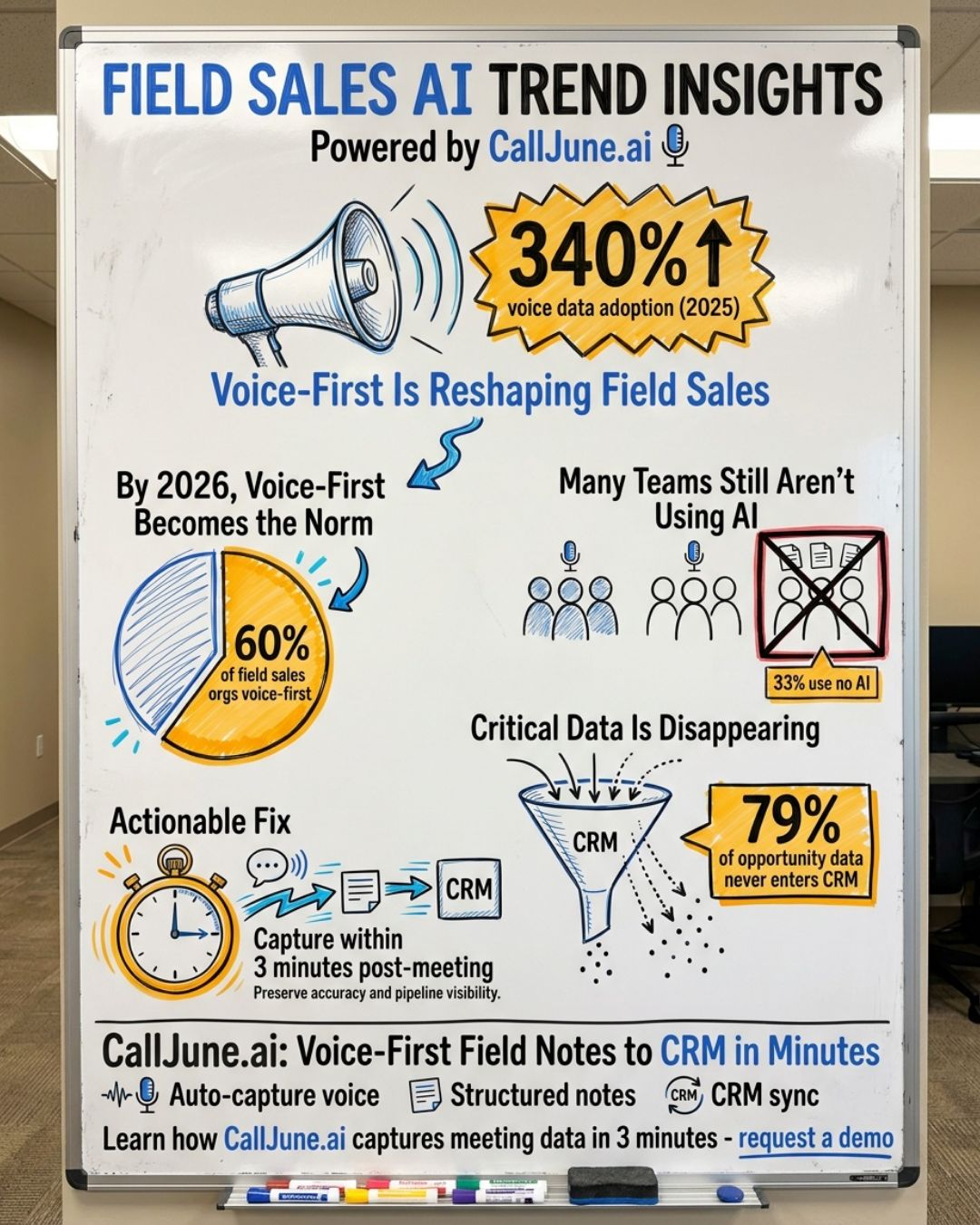
Voice-to-CRM adoption grew 340% in 2025.
By end of 2026, analysts expect 60% of field sales organizations to use voice-first data capture. That's up from 18%.
Fast shift. But the number that didn't make the headlines? 33% of field sales teams still aren't using AI at all. Not piloting. Not exploring. Nothing.
The Gap Nobody Is Reporting On
Most of the coverage on this trend focuses on who's adopting, which CRMs are adding voice features, and what enterprise rollouts look like.
That's the wrong frame.
The more important number is 79%.
79% of opportunity data never enters the CRM. That was true before voice AI became a category. It's still true for most teams today.
A Fortune 50 CPG company went from below 30% CRM completeness to above 90% in 90 days after switching to voice-to-CRM.
That jump is not a technology story. It's a workflow story.
What Changed and What Didn't
The data problem in field sales has always been the same. Reps are asked to document their meetings long after those meetings end.
From memory. At the end of the day. After 8 other meetings stacked on top of the one that mattered.
Only 23% of CRM data is accurate and complete, according to Salesforce's own research.
Reps lose real time to data entry and search every week, and the cost of that lost time and bad data compounds across a team.
That's not a motivation problem. That's a design problem.
We built a system that asks people to reconstruct what happened hours after it happened, filtered through optimism, exhaustion, and the pressure to make the numbers look right.
The 3-Minute Window
There is exactly one moment when a rep's recall is still accurate.
The walk from the meeting room to the car.
After that, the next call stacks on top. The afternoon ends. The week ends. What gets logged on Friday is a compressed, optimistic version of what actually occurred.
We call this Truth Decay. And every hour that passes after a meeting makes it worse.
Teams that capture data at the source, in the 3 to 5 minutes after the meeting, before it decays, report CRM completeness climbing to 85 to 95%.
That's not because their reps are more disciplined. It's because the workflow finally matches when the information actually exists.
The So What for Your Team
If you manage a field sales team, this trend matters for one reason:
The teams with 90%+ CRM completeness are not forecasting better by accident. They have cleaner data. Their managers can coach on real conversations, not Friday reconstructions.
When a rep calls in for a few minutes after a meeting, the manager gets something real to work with. When a rep batch-updates on Friday, the manager gets a story.
Teams using voice-to-CRM report getting real time back, a couple of hours a week per rep, returned from manual data entry to selling.
The Window Is Still Open
33% of field sales teams aren't using AI yet.
That's not a criticism. That's an opportunity. The competitive gap between teams that capture post-meeting intelligence and teams that don't is widening every quarter.
Wasted time compounds. Bad forecast data compounds. Coaching gaps compound.
The thing between a great sales call and your CRM is your rep's memory. And memory is unreliable at 6pm in a parking lot.
Voice-to-CRM doesn't fix that problem by making reps smarter. It fixes it by moving the data capture to the only moment where the data is still accurate.
There's a demo line at calljune.ai. Call it. It's a few-minute conversation, about the same length as the parking lot walk your reps are already taking.