
By Shawn Johnson, Founder, CallJune.ai. Published October 7, 2026.
Reps talk in code on the forecast call because the system asks them on Friday about a meeting that happened on Tuesday. The code is a recall problem, not an honesty problem. Call to CRM closes the gap. The rep calls June right after the meeting. She asks the questions a good manager would ask, and the answer reaches the CRM that day.
Why do sales reps talk in code on the forecast call?
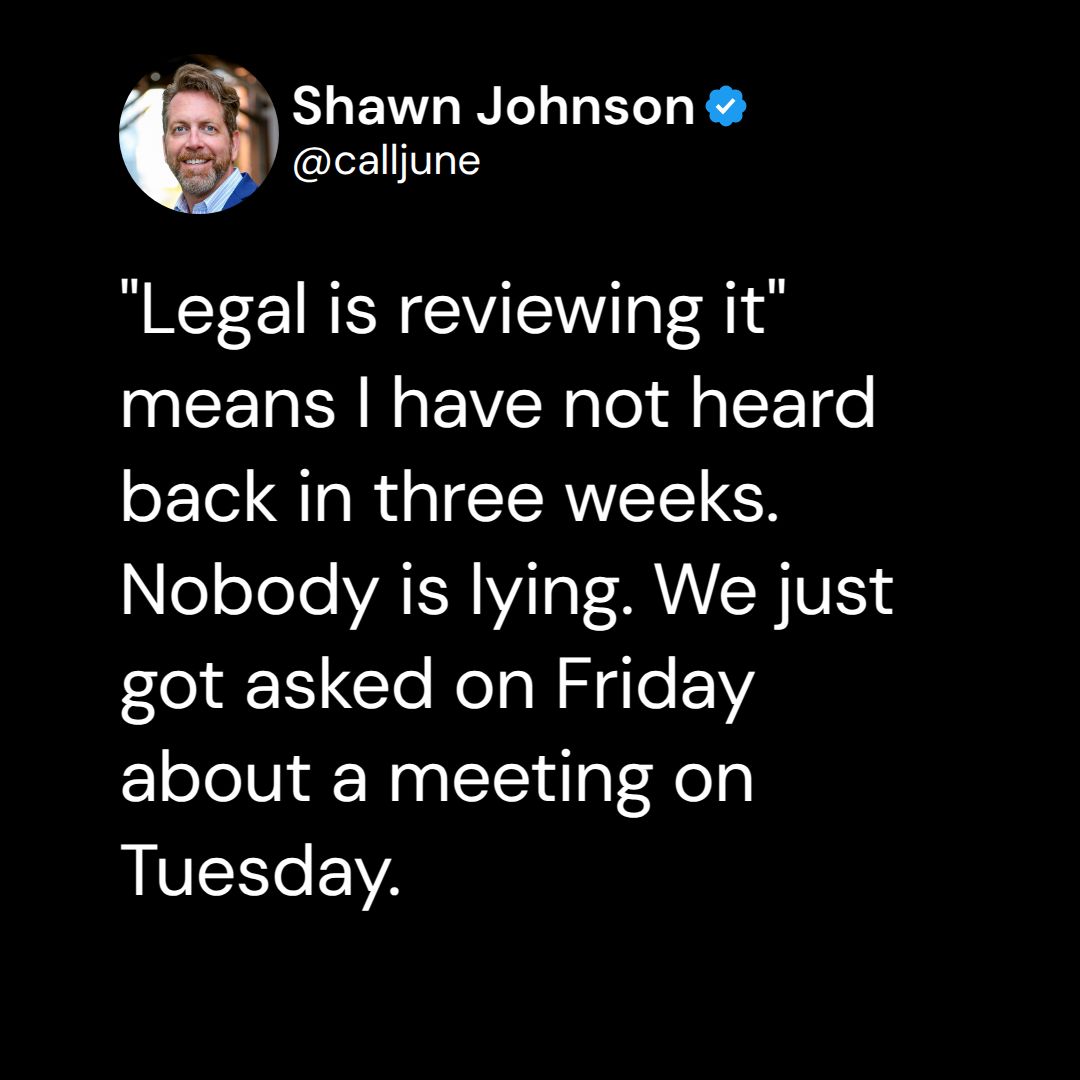
Every sales team has its own phrasebook. "Legal is reviewing it." "They are cautiously optimistic." "It pushed to next quarter." Everyone in the room can translate on the fly.
It is easy to read that as reps hiding the ball. That is not what is happening.
A rep walks out of a plant visit on Tuesday with a real read on the deal. He knows the buyer went quiet on timing. He knows the champion sounded less sure than last month. That read is sharp for about an hour.
Then he drives to the next stop. The week keeps going. On Friday a field asks him for a stage and a close date.
By then the detail is gone. What is left is a shape. He fills in the shape, and the shape is the code.
What does "legal is reviewing it" usually mean?
Most often it means the rep has not heard back in a few weeks and does not know why.
That is a real and useful piece of information. It is also the kind of thing a rep says plainly only when somebody asks him directly. In a conversation, close to the moment, rather than in a field on Friday.
"Cautiously optimistic" works the same way. It is what a rep says when he is asked to commit to a feeling he has not examined. Ask him what the buyer actually said and you get something you can act on.
Why do sales leaders discount every rep's number?
Because they learned to. A VP who has been burned twice starts taking a quiet haircut off every number in the room.
Here is the part nobody says out loud. The reps know he does it. So they pad the number he is about to cut.
Now two people are guessing at each other in a meeting whose whole job is to produce a number. The leader then carries that number into a board meeting and has to sound confident about it.
Nobody in that chain is acting in bad faith. The inputs were never good.
Is this a discipline problem or a timing problem?
It is a timing problem, and that distinction decides what you do about it.
If it is discipline, you add a reminder, a field, or a Monday nag. Teams have tried that for twenty years. The nagging makes the leader miserable too. Nobody took a sales management job to chase fields.
If it is timing, you change when the question gets asked. That is a smaller change and it actually works.
The honest moment and the capture moment are not the same moment today. The honest moment is in the car. The capture moment is Friday afternoon.
What changes when the answers land the day of the meeting?
The rep calls a phone number on the way out of the parking lot. June picks up and asks him the questions his manager would ask. What did the buyer say about timing. Who else has to sign. What would stop this.
It takes three to five minutes. No app, no login, no typing. June writes the structured update into the CRM.
Then the forecast call starts from what happened instead of from what somebody could still remember. The code is not needed, because the answer is already in the record.
For a leader, the payoff is coverage. Your own best questions get asked after every meeting. In every territory, whether or not you were in the room.
Frequently asked questions
Why is CRM data worse for field sales than for inside sales?
An email logs itself. A video call logs itself. A handshake in a customer's lot leaves nothing behind unless the rep writes it down later, from memory.
Does June record the customer meeting?
No. June is never in the meeting. The rep calls her afterward and talks it through. Call audio and transcripts are retained in the voice platform. Immediate deletion after processing is a configurable setting. We can enable it for you before go-live on request.
How is this different from voice dictation in my CRM?
Dictation captures what the rep chose to say. June asks the questions nobody asked him. That is the difference between logging a call and coaching a deal.
Does the rep need a special phone or an app?
No app and no login. The rep calls from a phone number registered with June and enters a personal PIN. Those two factors are how she knows who she is talking to.
Which CRMs does this write to?
HubSpot is the native integration and most teams are live in about a day. Salesforce is configured during onboarding. If a team has no CRM yet, June writes to a shared Google Sheet and can be repointed later.
Source note: the forecast-call phrasebook and the leader's haircut come from conversations with sales leaders and former enterprise reps. They are not survey findings. CallJune has one signed design-partner pilot and no published outcome data.