
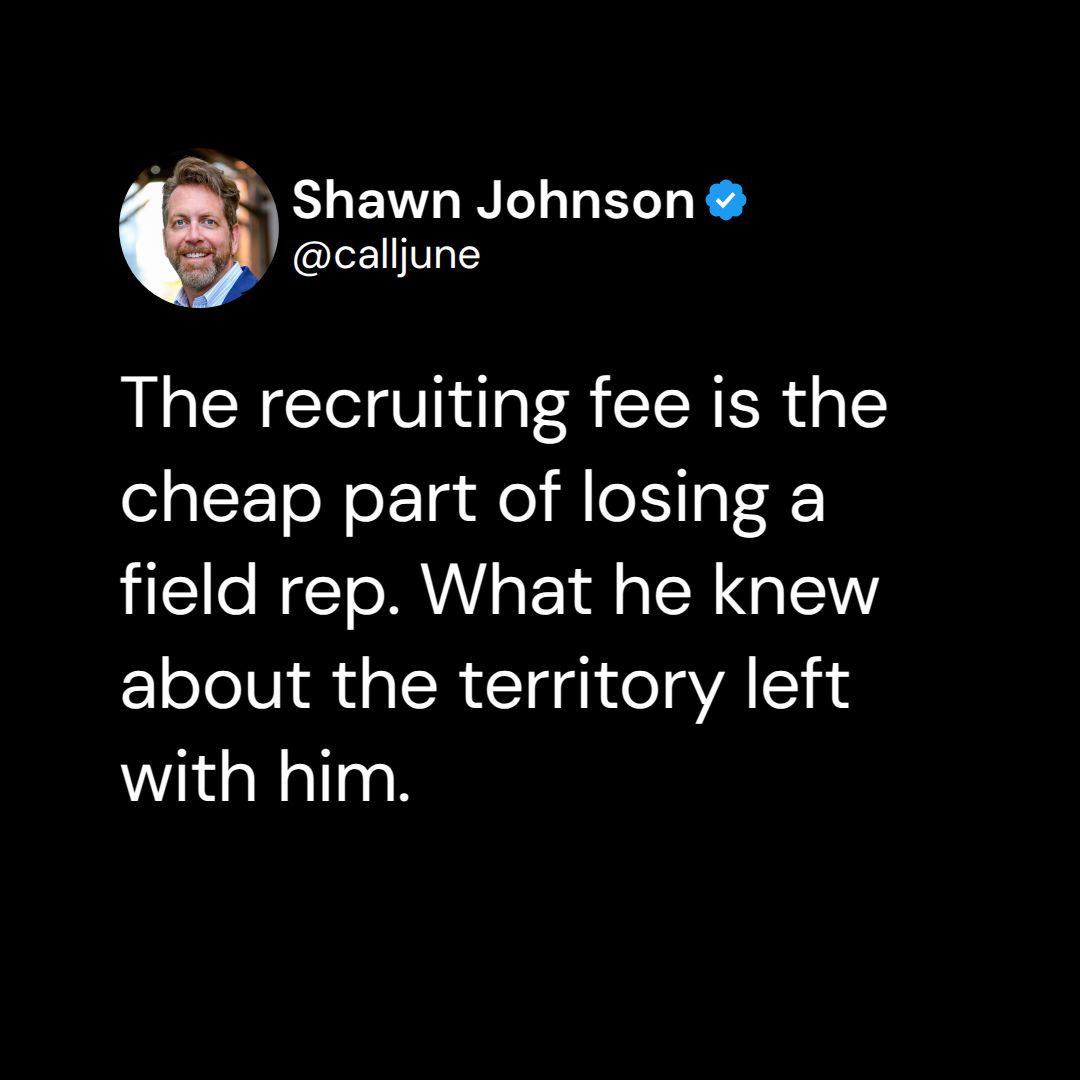
The short answer. The expensive part of losing a field sales rep is rarely the recruiting fee. It is the account knowledge nobody ever wrote down. Who actually signs. What was promised on the last visit. Which deal had already gone quiet. That knowledge sat in one person's head because nothing in the workflow ever asked him for it. A handoff document written in a final week does not get it back. The durable fix is to build the record while the rep is still driving the territory. That is what Call-to-CRM does. The rep calls a number after a visit, June asks the team's own questions, and structured notes land in the CRM the same day.
What actually leaves when a field rep leaves?
Picture a manager riding along with a new rep in his second week. Fourth stop, the buyer asks how the thing they agreed to back in June is coming along.
Neither man in the truck knows what she is talking about. The rep who knew left in July.
That is the real bill. Not the recruiting fee. The company already paid, in salary and windshield time, to learn that building. Who signs. Which relationship holds the account together. Which deal quietly stopped moving in March. It paid once, and it is about to pay again.
None of it was a secret. The departing rep would have told anyone who asked. Nothing asked.
How bad is field sales turnover, really?
SPOTIO's State of Field Sales 2026 surveyed 452 sales professionals. More than a third of field teams report annual rep turnover of 50 percent or higher. Roughly four in ten organizations need three months or more to get a replacement fully productive.
One note for anyone citing those numbers. The SPOTIO page reports turnover as both 34 percent and 41 percent in different places. It reports onboarding time as both 40 percent and 42 percent. The honest reading is "more than a third" and "roughly four in ten." Both are true under either figure.
The hiring continues regardless. In the same survey, 55 percent said they will definitely grow the field sales team in the next year. SPOTIO's own phrase for adding headcount without fixing the systems underneath is pouring water into a leaky bucket.
Why doesn't a handoff document solve it?
Because of when it gets written.
The departing rep sits down in his final week and reconstructs eight months of drives from memory. He is already half gone. He captures the outline and loses the judgment, which was the valuable part. He remembers last Tuesday's meeting. He does not remember the throwaway comment in April that turned out to be the reason the deal stalled.
Even a conscientious rep cannot do this well. Recall decays fast. It decays worst on the read, which is exactly the part a manager needed.
What does a territory with a memory look like?
It looks like a CRM holding the last six months of visits in the rep's own words. Each one entered the day it happened.
That is not a documentation project bolted on at the end. It is a capture step that runs after every meeting, for every rep, whether or not anyone is leaving. When someone does leave, nobody reconstructs anything. The reconstruction already happened, one drive at a time.
The mechanic is deliberately boring. The rep calls a number on his way out of the parking lot. June picks up and asks the team's own qualifying and risk questions. The rep talks it through the way he would debrief a manager on the drive home. The call runs three to five minutes. No app, no login, no typing. Structured notes land in the CRM the team already runs. If there is no CRM yet, they land in a shared sheet.
Does this replace the coaching conversation?
No, and it is worth being clear about that. A guided debrief is an input, not a substitute for a manager.
What it changes is where the 1:1 starts. Today the manager spends the first third of the meeting finding out what happened. With the debrief on the record, he arrives already knowing, and spends that time on what to do next.
The continuity benefit is a side effect. You build the record for coaching reasons, and it happens to survive the rep.
Frequently asked questions
What is the real cost of losing a field sales rep?
The account knowledge that never made it into a system. The replacement rebuilds it in the middle of live deals. Roughly four in ten organizations need three months or more to get that person fully productive.
Will a handoff document fix it?
Only partly. It is written from memory in a final week, so it captures the outline and loses the judgment. The rep is reconstructing months of meetings, and he is already focused on the next job.
How do you keep territory knowledge when a rep leaves?
Build the record continuously instead of at the end. A short guided debrief after each meeting puts the rep's read into the CRM the same day. The history already exists before anyone resigns.
How long does a post-meeting debrief take?
Three to five minutes. The rep calls a number, June asks the team's questions, and the answers are written to the CRM after the call.
Does the customer get recorded?
No. June is never in the customer meeting. She talks to the rep afterward.
Source: the 452 field sales professionals SPOTIO surveyed for The State of Field Sales 2026. Page fetched and verified live September 8, 2026. By Shawn Johnson, Founder, CallJune.ai.