
By Shawn Johnson, Founder, CallJune.ai.
Published October 21, 2026.
TL;DR. CRMs collect required fields because every new leader arrives with a fair question. A leader puts that question in the CRM because that is where everyone looks. Almost nobody goes back to retire a field. One person absorbs the cost. The rep answers all of those questions by typing, usually after his last stop of the day. Call to CRM changes who fills the fields in, not which fields exist. The rep calls June after a visit. She runs a guided conversation of three to five minutes. The structured answers land in the CRM the company already runs.
Why do CRMs end up with so many required fields?
Every field has a person behind it, and in almost every case that person was right to ask.
A board member asks who else is bidding. So a competitor field appears, and next quarter the answer sits in the system instead of in somebody's head. A CFO asks when revenue lands. That becomes a close quarter field. Somebody in marketing wants to know which campaigns produce. Now there is a lead source field.
None of those people were wrong. Each one asked a question once. A field answered it. Then the field stayed.
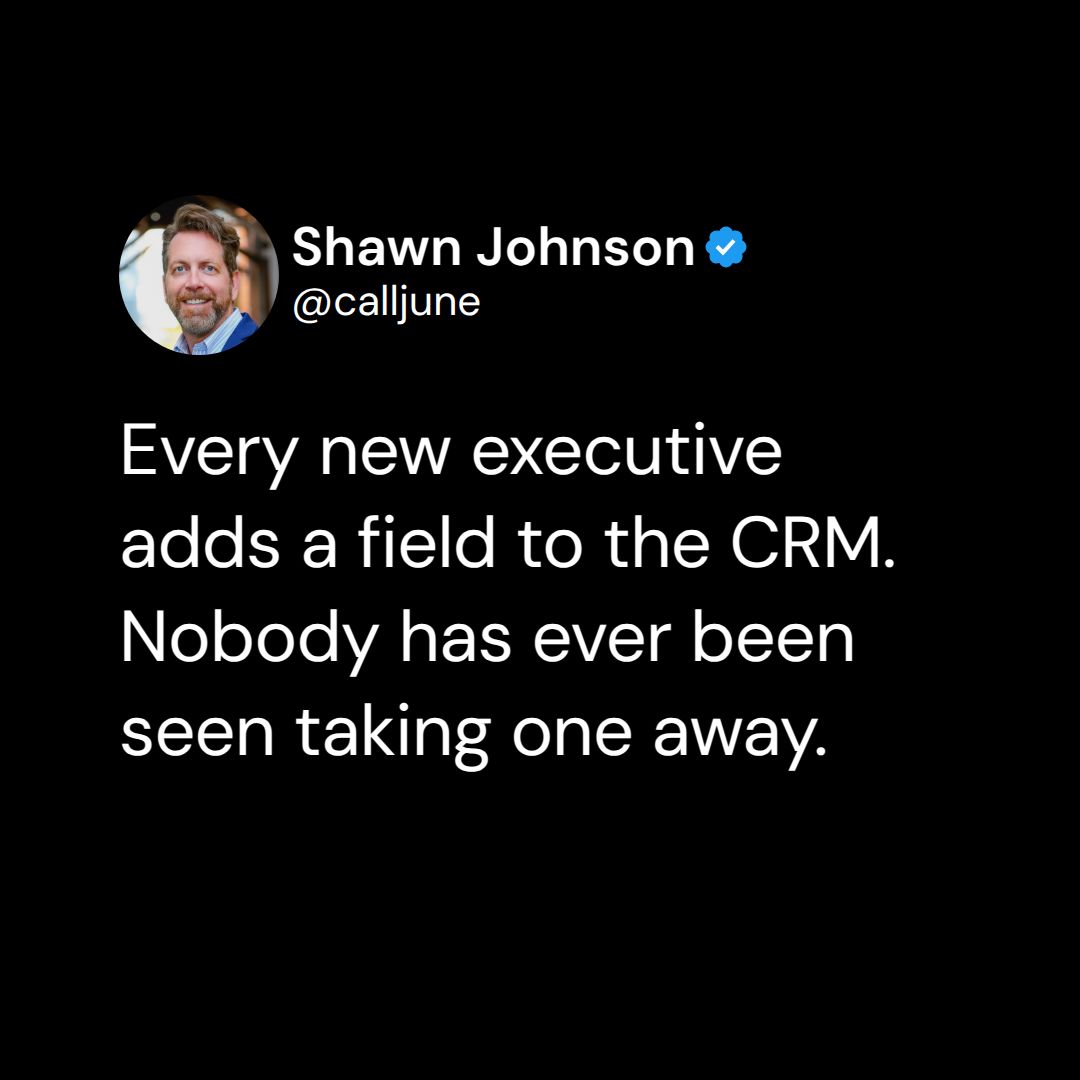
A new VP of Sales starts in March. By April there is one more box on the form. She gets her answer and moves on. The box does not move.
Whoever has a question can add a field. Nobody owns taking one away. So the form grows by accumulation rather than by design.
Who actually pays for a growing CRM form?
The rep pays. He pays in a truck or at an airport gate, after his last call of the day. He works from memory.
A field rep who saw five accounts this week is carrying the useful material in his head. The competitive read. Whether the champion is really a champion. What the buyer said about timing that did not match last month. That material has a short shelf life.
By the time he opens the opportunity record, he is not thinking about any of it. He is scrolling a form. Required boxes have to be cleared before the record saves, so he clears them. "Other" does a great deal of work on a crowded form. The box is filled and the answer is worth nothing.
The frontline manager sits on the other side of the same problem. He carries twelve to fifteen reps. He took the job to coach them. Instead a real share of his week goes to asking people about boxes. He did not design the form either. He is just the one who has to chase it.
How do you reduce CRM data entry for field reps?
Three fixes get proposed. Delete fields. Make fewer of them required. Or buy a tool that fills the form from recorded meetings.
Each one runs into something. Deleting a field means relitigating the question with whoever asked it. Making fields optional produces blank records instead of shallow ones. Recording tools work where meetings get recorded. Field meetings happen in a buyer's conference room or on a plant floor, and nobody is recording those.
There is a simpler move, and it has nothing to do with the form. Change how the questions get asked.
Salespeople talk for a living. Ask a rep the same questions in a conversation, one at a time, the way a person would, and he answers all of them. He will not notice he is updating anything. That same rep abandons a twelve-box form in the parking lot.
That is what Call to CRM means. The rep calls June from the lot after the visit. She asks what the fields were built to find out, the way a good manager would on a ride-along. Who else is in the deal. What the buyer actually committed to. What has to be true for this to close in the quarter.
The call runs three to five minutes. No app, no login, no typing. June writes the structured result into the CRM the company already runs, or into a shared sheet if there is no CRM yet.
Every stakeholder keeps their question. The rep answers out loud instead.
Do you have to delete CRM fields to fix this?
No, and that is usually the wrong fight. Each field is a real question from a real person. What actually binds is what a tired person will do at the end of a long day. Typing is not on that list. Taking two boxes off the form does not change it.
Change the input and the form stops standing between your rep and your pipeline.
FAQ
Why do CRMs end up with so many required fields?
Each new leader adds a reasonable question. A field gets added to answer it. Fields are rarely retired.
How do you reduce CRM data entry for field reps?
Let him answer out loud, right after the visit, while he still remembers the room. A guided phone debrief collects the same information in a few minutes.
Do you have to delete CRM fields to fix this?
No. The fields can stay. The change is who fills them in, and how.
Does the rep have to install anything?
No. He calls a phone number from a registered mobile and has a conversation. There is no app and no login.
CallJune is Call to CRM for field sales teams. The rep calls June after a meeting, she runs a guided debrief, and the CRM gets updated. Try it: (949) 731-5466, or at calljune.ai.