
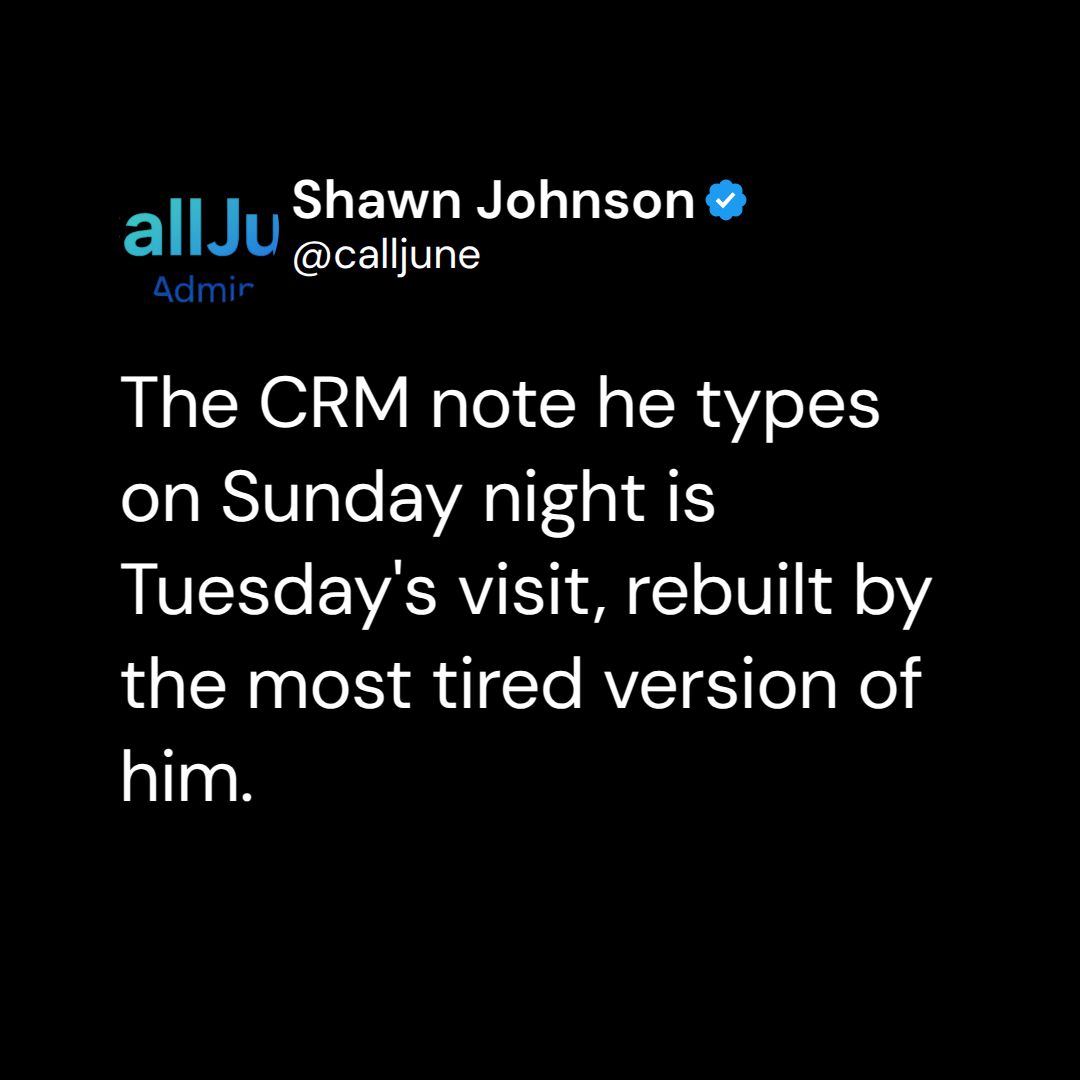
The short answer. Reps update the CRM at night because the day belongs to customers. The record is due before the next call, so the writing waits for the evening. The problem is not the hour. A note written on Sunday is Tuesday's meeting rebuilt from memory, so it holds the least of what the rep concluded. Call to CRM moves the ask to the moment the meeting ends. The rep calls June from the lot. She asks the team's own questions in a guided debrief. The typical call runs three to five minutes, and structured notes land in the CRM the company already runs.
Why do sales reps update the CRM at night and on weekends?
Because that is when the selling stops. A field rep with four visits booked has no gap wide enough to write any of them up. The admin waits for the evening, and often for the end of the week.
The numbers point the same way. Pipedrive surveyed 1,000 US sales and marketing professionals in June 2026. Every respondent uses a CRM, or works where the sales team does. 85 percent said they work late at least once a week. The reason given was manual admin spilling past standard hours. (Pipedrive, 2026-08-04)
That is a vendor survey, and the sample is sales and marketing people. It is not a field-only group. Read it as the shape of the problem, not a measurement of any one team.
How much of the sales week goes to logging activity instead of selling?
In the same survey, only 11 percent counted closing deals among the things they do most often. 38 percent said most of their time goes to logging calls, emails and meetings.
Set those two figures side by side. The activity that pays is not the activity that fills the week.
Does a CRM note written at night actually hurt data quality?
Yes, and this matters more than the hours.
A record typed on Sunday night describes a meeting that happened on Tuesday. Everything in it is recall. The rep is reconstructing the room days later, at the end of a long week.
So the note is thin in a specific way. The facts usually survive. The rep's read does not.
His sense that the champion has gone quiet. The second decision maker who appeared. The timeline slipping for a reason nobody said out loud. That is the expensive part, and it fades first.
Then Monday's call runs on it. The leader builds a forecast from stage fields and a paragraph written late. Nobody in that room is lying about any of it.
Why is nagging reps the wrong fix?
Because nobody in the picture is being lazy, including the manager.
The manager sends the "update your opps before tomorrow" note at 7pm on a Sunday. He does not enjoy sending it. He took the job to coach a team, not to chase fields. He sends it because the data he needs for an 8am call is not there. Asking again is the only move he has.
A reminder can move the note from Sunday night to Monday morning. It cannot add what was never captured.
How can sales managers get fresher CRM data without the after-hours chase?
Move the ask to the moment the meeting ends, and make it a conversation instead of a form.
That is what Call to CRM does. The rep calls June from the parking lot, the truck, or the airport. June picks up and asks the questions his manager would have asked. These are the qualifying probes a good leader uses on a ride-along. The rep talks it through. The typical debrief runs three to five minutes.
June writes the structured update to the CRM the company already runs. If there is no CRM yet, she writes to a shared sheet instead.
There is no app to download, no login, and no typing. June is never in the customer meeting, so nothing in that room is recorded. The rep always calls June. She does not call him.
Two things follow that are worth more than the time saved. The record carries the rep's own read while he still has it. And the same five questions get asked after every meeting, in every territory. That is how a leader's judgment reaches a rep who is three hours away.
Sunday night goes back to being Sunday night.
FAQ
Why do reps update the CRM at night?
Because the day is full of customers and the record is due before the next call. In Pipedrive's June 2026 survey, 85 percent said they work late at least once a week. The cause given was manual admin spilling past normal hours.
Does late data entry hurt data quality?
It is written from memory, a day or more after the meeting. So it holds less of what the rep actually concluded. The facts tend to survive and the rep's read tends not to. A short debrief right after the meeting fixes it.
How much of a seller's week goes to logging activity?
In that same survey, 38 percent said most of their time goes to logging calls, emails and meetings. Only 11 percent counted closing deals among the things they do most often.
How do you get fresher data without nagging reps after hours?
Give the rep a way to answer the manager's questions while the meeting is still in his head. He uses a phone he already carries. Then there is nothing left to chase on Sunday.
How long does a debrief call take?
Typically three to five minutes. June asks the questions and the rep talks. There is no app, no login and no typing.
By Shawn Johnson, Founder, CallJune.ai. Published 2026-10-14.
Source: Pipedrive newsroom, "The Modern Salesperson Is Becoming a Data-Entry Clerk," 2026-08-04. National online survey of 1,000 US sales and marketing professionals, fielded June 2026. Link verified live 2026-10-13.